

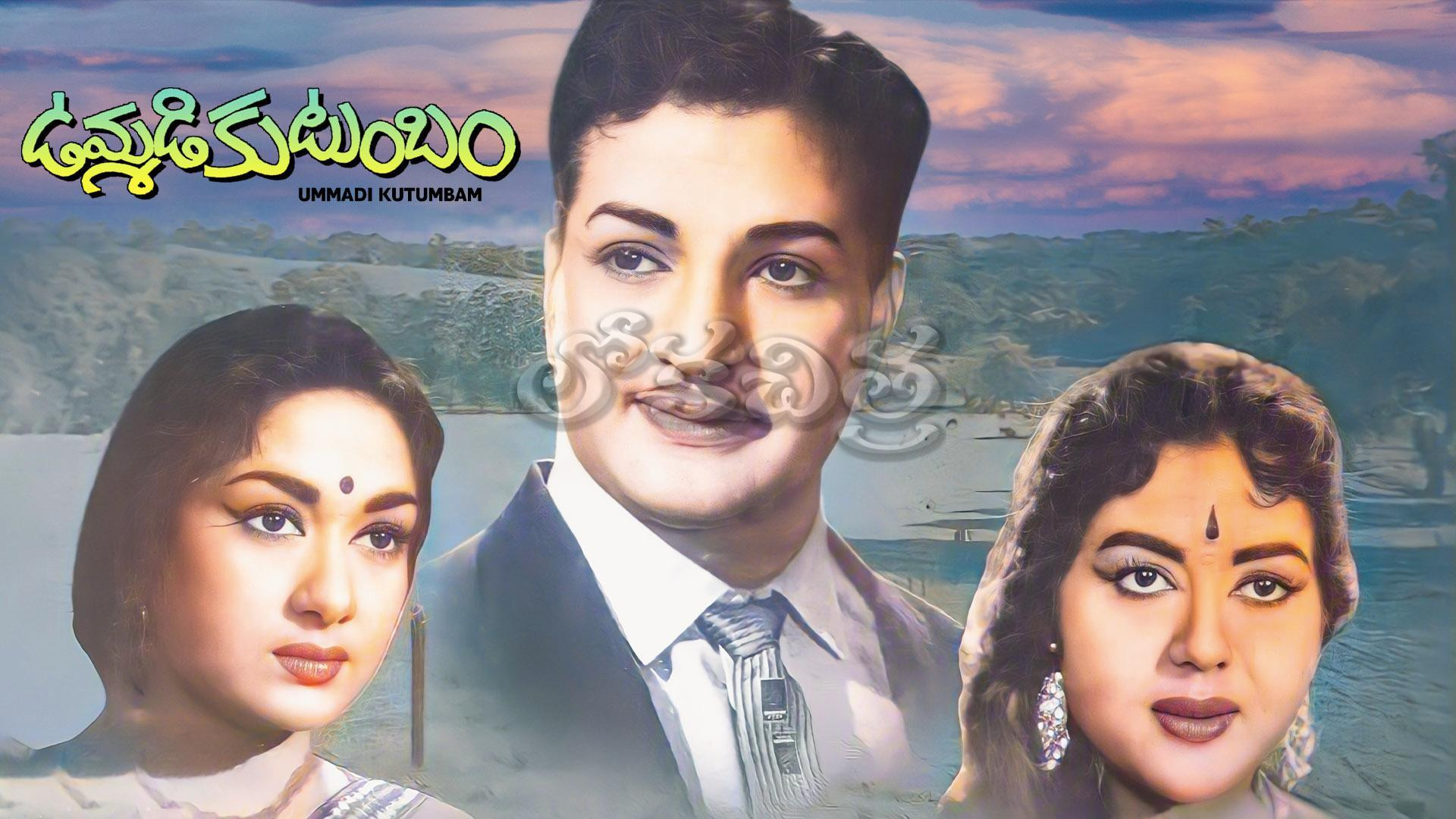
“Ummadi Kutumbam” – A Family Classic Released on April 20, 1967, Ummadi Kutumbam stands tall as one of Telugu cinema’s most meaningful family dramas—jointly produced by Ramakrishna and N.A.T, directed by visionary filmmaker Dasari Yoganand, and presented under the banner of Ramakrishna–N.A.T. Combine.
On completing 58 glorious years this April, this cinematic gem reminds us once again of the deep-rooted values of joint family life, a concept that feels even more vital in today’s rapidly individualistic times.
At Arava Bioscope, we take pride in revisiting masterpieces that mirror the social fabric of their era. Ummadi Kutumbam is one such cinematic mirror that reflects the beauty of collective living, affection, and emotional bonding within a traditional Telugu household.
The Opening Scene – A Stage Within a ScreenThe film opens with a remarkable meta-theatrical scene set outside Vahini Studios, showcasing a dramatic stage play titled Sati Savitri.
Inside this open-air theater set, we witness Gadusumilli Ramayya in the role of Yama Dharma Raja, a role portrayed with commanding presence by N.T. Rama Rao.
Alongside him appears Rajababu as the humble Satyavan, with Vani Sri bringing alive the character of Savitri. Though her screen time here is brief, Vani Sri’s expressive acting left an early impression that paved her journey to become one of the most beloved leading ladies of Telugu cinema.
Inspired by her portrayal, K. Shankar Reddy later recreated Sati Savitri in 1978 with NTR once again in the lead—a beautiful coincidence that ties the two films together across a decade.
The Performers Who Defined an EraThe film also features a heart-stirring scene where NTR and Savitri appear as brother-in-law and sister-in-law (maradalu–vadina), showcasing their effortless chemistry and dramatic brilliance.
If we are to speak of brilliance, one cannot pass without dwelling upon Savitri’s extraordinary artistry.
The moment the director called “Action!”, she transformed—her eyes, expressions, and subtle gestures magnetically drawing the audience in.
Through her role as a modest daughter-in-law, she embodied a natural grace and quiet strength that lived and breathed every nuance of a traditional Telugu woman.
Savitri didn’t merely act; she became the character. With just a glance, a shy smile, or a soft word, she mesmerized the camera like no other. Truly, she was the one unmatched Mahanati—the immortal queen of emotion.
And then there was NTR—majestic yet tender, dignified yet humble. Even as the senior-most star on set, he blended seamlessly with the younger cast, proving that true greatness lies in collaboration.
As the youngest son “Ramu” in the story, NTR breathed life into the character—a man simple by education, yet rich in heart; a lover of stage plays, always caught between art and family duty. His interactions with Vani Sri, Rajababu, and others revealed his generosity as a co-actor and his unmatched leadership as an artist.
The Heart of the Story – One Mother, Four Sons
The story, as the title suggests, revolves around a joint family—a mother with four grown sons:The eldest, Nagayya, a humble office clerk, married to a strong-willed Gauri (Surya Kantham).
The second, Chandram (S.V. Ranga Rao), a farmer married to the spirited Kantham.The third, Dr. Mukundam (Prabhakar Reddy), who falls into the temptation of city life, neglecting his wife Rama (Savitri).
And the youngest, Ramu (NTR), a kind soul with a passion for drama, played opposite Krishna Kumari.
As misunderstandings tear the family apart—love turns cold, egos clash, and hearts break—the aged mother watches helplessly as the home she built crumbles. Seeing this pain, Ramu decides to take matters into his own hands.
His journey to the city leads him to the wealthy Sarada, whose father, a zamindar, recognizes Ramu’s noble heart. What unfolds is a chain of heartfelt revelations and reconciliations where truth, kindness, and familial love triumph over misunderstanding.
By the end, all estranged members reunite, the mother’s heart finds peace, and the story closes on a soulful note of harmony.
The Team Behind the Classic
The film’s stellar cast included Relangi, Surya Kantham, S.V. Ranga Rao, Prabhakar Reddy, Savitri, NTR, Krishna Kumari, Vani Sri, Rajababu, Hemalatha, Allu Ramalingaiah, and many more.
Written by Samudrala Jr., the songs penned by C. Narayana Reddy, Kosaraju, and Samudrala Jr. remain evergreen hits. T.V. Raju’s music lifted the soul of the film, complemented by Ravikant Nagaich’s cinematography.
The musical landscape was rich and melodic—songs like the legendary “Povuchunnava O Yama Dharma Raja” rendered by Ghantasala and P. Suseela became instant chartbusters, while NTR’s dances with L. Vijayalakshmi in “Hello Hello My Dear Hello” and “Chethiki Chikkave Pitta” had audiences applauding in delight.
Legacy and Global Recognition
Ummadi Kutumbam celebrated 100 days in over 17 centers, even running 197 consecutive days at the Durga Kala Mandir Theatre in Vijayawada—a monumental record at the time.
The film also earned international acclaim, being screened at the Moscow Film Festival in 1968.
Today, as we look back at Ummadi Kutumbam’s glorious journey, we are reminded not only of its cinematic excellence but of the values it upheld—love, unity, humility, and forgiveness.
It remains a glowing tribute to NTR’s genius—an actor, storyteller, editor, and director who defined the golden age of Telugu cinema.
About The Author